Lung cancer may be caused by asbestos but is more commonly caused by smoking and environmental exposure. Malignant pleural mesothelioma affects the lungs and accounts for 75% of all mesothelioma diagnoses.
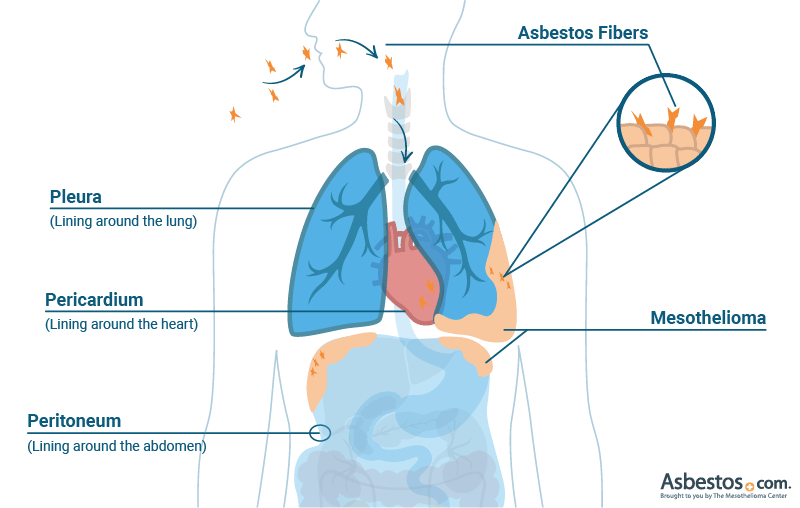
Mesothelioma is a malignant tumor that is caused by inhaled asbestos fibers and forms in the lining of the lungs, abdomen or heart. Symptoms can include shortness of breath and chest pain. The life expectancy for most mesothelioma patients is approximately 12 months after diagnosis. Treatment may improve prognosis and can include surgery, chemotherapy or radiation.
Differences Between Mesothelioma & Lung Cancer Development
While mesothelioma and lung cancer can develop after exposure to asbestos, each occurs in different areas of the body. Lung cancer develops in the lung itself, while mesothelioma usually develops in the lining of the lung. Mesothelioma can also develop in the lining of the abdomen, heart or testes. Mesothelioma of the lung is called pleural mesothelioma.
The two cancers grow differently. Lung cancer tends to grow in individual masses, known as nodules, with defined boundaries. Mesothelioma starts as tiny tumor nodules that scatter the mesothelial lining, and eventually grow together to form a sheath-like tumor around the organ.
Lung cancer has a tendency to spread or metastasize early to other organs, while mesothelioma tends to be a more locally aggressive disease that remains within one body cavity.
Another major difference is the incidence rate of the two conditions. Lung cancer is the second-most-common cancer in the U.S. with about 222,500 new cases annually.
Doctors diagnose roughly 2,800 cases of malignant mesothelioma, which includes all four types of the asbestos-related cancer, each year.
Mesothelioma is almost exclusively the result of asbestos exposure, while the majority of lung cancer cases are attributed to tobacco use and environmental exposures to substances such as radon gas and secondhand smoke.
FACTS ABOUT LUNG CANCER
- 90 percent of all lung cancer deaths are attributed to tobacco use.
- Radon exposure is the second-leading cause of lung cancer.
- Lung cancer has a shorter latency period and may appear 10 to 30 years after first exposure to a carcinogen like asbestos or cigarette smoke.
Similarities Between Mesothelioma and Lung Cancer
Death rates by state for mesothelioma and lung cancer tend to correlate with each other. The five states with the most mesothelioma deaths also have the most lung cancer deaths.
Each disease can take decades to develop yet only months to spread to distant organs. Both have similar diagnostic procedures and treatment techniques.

In addition, lung cancer and mesothelioma have overlapping symptoms. They both commonly cause chest pain, coughing, difficulty breathing, fatigue and weight loss. If a patient has these symptoms along with a history of asbestos exposure and/or a history of smoking, doctors should immediately suspect lung cancer or mesothelioma.
But despite having a number of similarities, lung cancer and mesothelioma differ in physical characteristics and non-asbestos risk factors.
Diagnosing Mesothelioma and Lung Cancer
To diagnose either type of cancer, a doctor will need to perform a biopsy. The appearance on CT scan or PET scan alone is not a reliable way to differentiate between lung cancer and mesothelioma. Biopsies may be performed via a bronchoscopy, needle biopsy or thoracoscopic surgery.
During a bronchoscopy, the doctor inserts a small camera down the throat and into the airways of the lung to detect abnormalities such as visible tumor growth. If the doctor finds irregular growth, he or she may collect a cell sample and test it for cancer.
A needle biopsy involves placing a small needle into the tumor using an ultrasound machine or CT scan to localize it. The procedure is performed under local anesthesia.
To collect a larger sample, however, a minor biopsy surgery under general anesthesia is required. A small camera is inserted between the ribs to look inside the chest and obtain samples of the fluid. During this procedure, fluid buildup may be suctioned out and a pleurodesis performed to decrease the risk of the fluid collecting again.
Most patients with pleural mesothelioma will either show pleural thickening (extensive scarring in the lining of the chest cavity) or a pleural effusion, which is fluid buildup in their chest cavity. This fluid may be tested for cancer cells, but it isn’t a reliable way to confirm a diagnosis.
With lung cancer, you don’t necessarily have the thickening of the lining of the chest cavity. However, it is not uncommon for lung cancer patients to present with pleural effusions, which can sometimes make it difficult to establish the diagnosis.
Treating These Cancers
For mesothelioma and lung cancer, treatment options largely depend on how much the cancer has spread, which is also referred to as the stage of the cancer. Most treatment plans include some combination of surgery, radiation therapy or chemotherapy.
If the cancer is localized to the lung area, surgery may be able to remove all of the tumor growth. But surgeries vary by specific type of cancer.
EXAMPLES:
- To treat pleural mesothelioma a surgeon may remove the lining of the lung, the affected portion of the lung or the entire cancerous lung and its linings.
- Typical lung cancer surgeries include removing a small portion of the lung, a lobe of the lung or the entire lung.
For both types of cancer, chemotherapy and radiation therapy are also considered as possible additional approaches to treatment. If the mesothelioma or lung cancer is localized, either treatment can be used to shrink tumor growth and potentially kill all tumor cells. When used in this potentially curative way, chemotherapy and radiation therapy are typically combined with surgery. These treatments can still be used if the cancer has spread beyond its original location. In these cases, treatments are palliative and aim to reduce symptoms.
Experimental therapies are being tested through clinical trials for both cancers. Some of these innovative therapies include immunotherapy, gene therapy, photodynamic therapy and cryotherapy. Photodynamic therapy is used more routinely in the treatment of lung cancer than in mesothelioma.
What Is Mesothelioma Cancer?
Malignant mesothelioma is a rare, incurable, asbestos-related cancer that usually affects the lining of the lungs. This cancer is known as pleural mesothelioma. But mesothelioma tumors can also form on the linings of the abdomen, heart and testes.
KEY FACTS ABOUT MESOTHELIOMA
- More than 3,000 cases of mesothelioma are diagnosed yearly in the United States.
- Pleural mesothelioma accounts for 75% of cases.
- Average age of mesothelioma patient is 69.
- Men represent the majority of mesothelioma diagnoses.
- Average life expectancy for mesothelioma patients is 12 to 21 months.
Mesothelioma Symptoms
Symptoms of mesothelioma appear when tumors spread, grow and press against the chest wall and the abdominal cavity. Chest pain and shortness of breath are the most common symptoms.
COMMON MESOTHELIOMA SYMPTOMS
- Dry coughing
- Shortness of breath
- Respiratory complications
- Pain in the chest or abdomen
- Fever or night sweats
- Pleural effusion (fluid around the lungs)
- Fatigue
- Weakness in the muscles